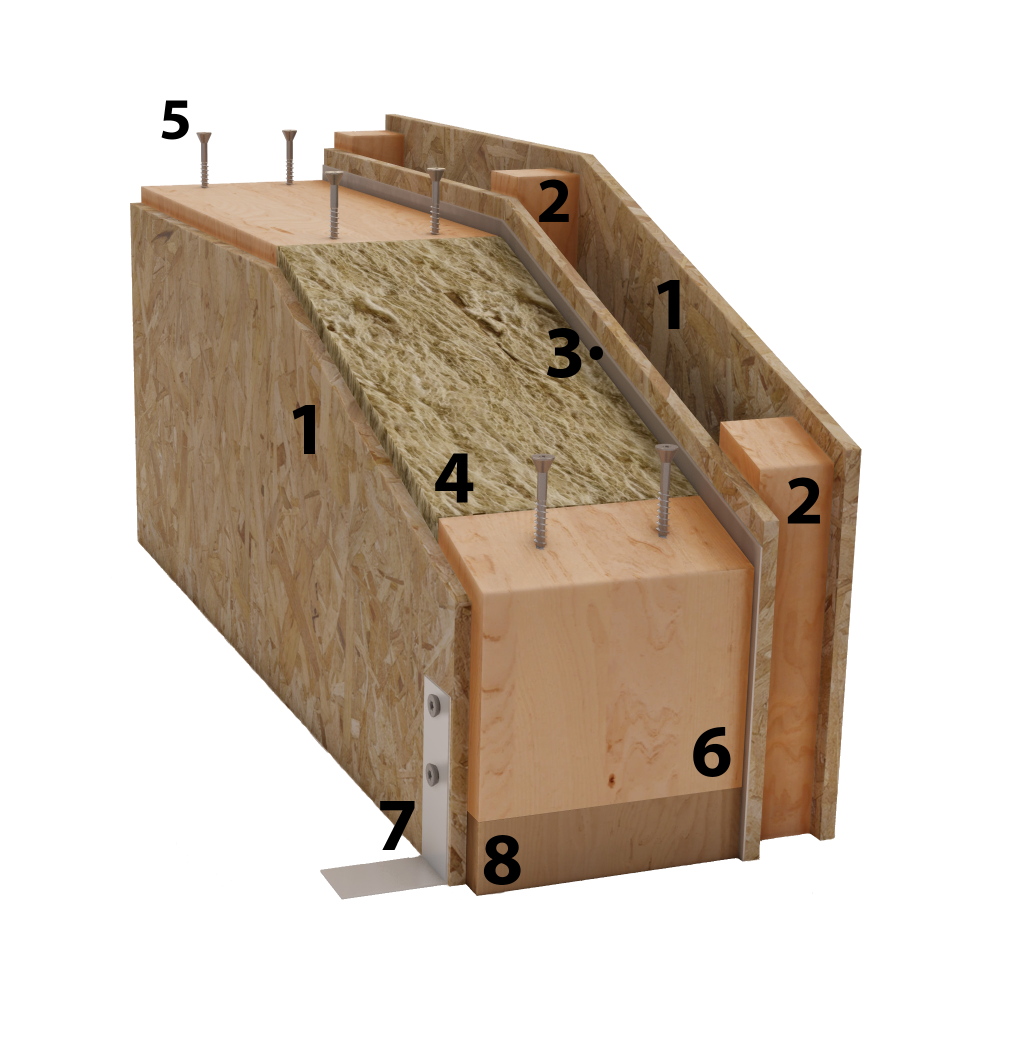
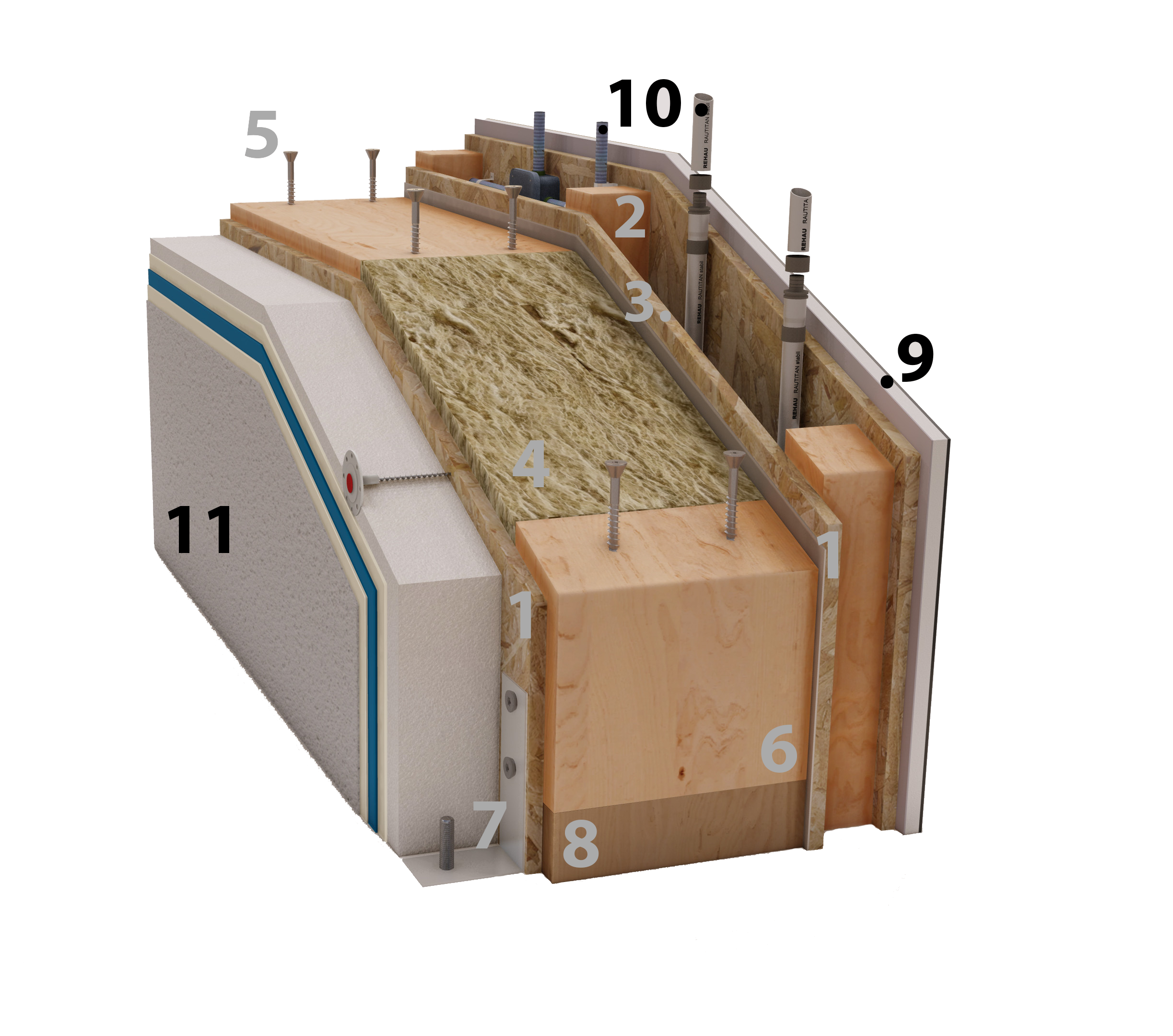
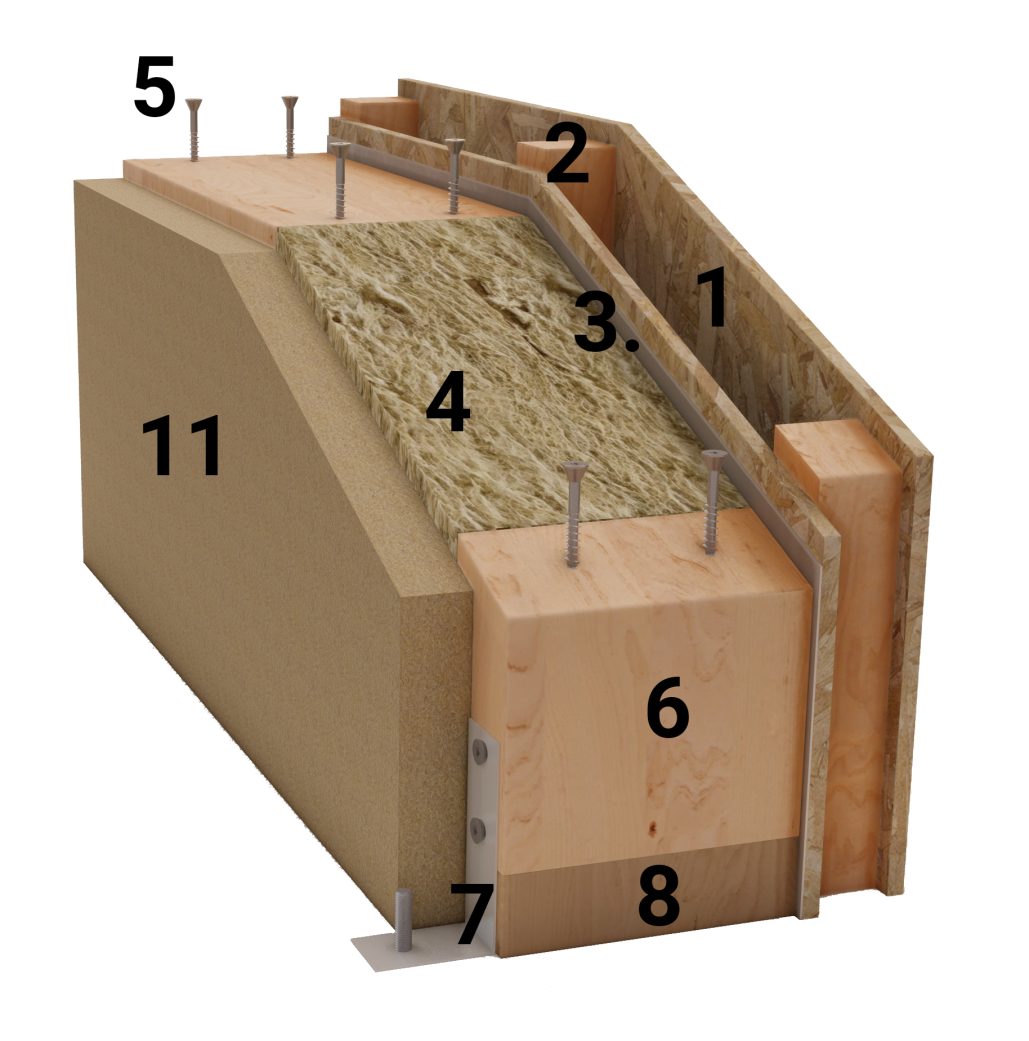
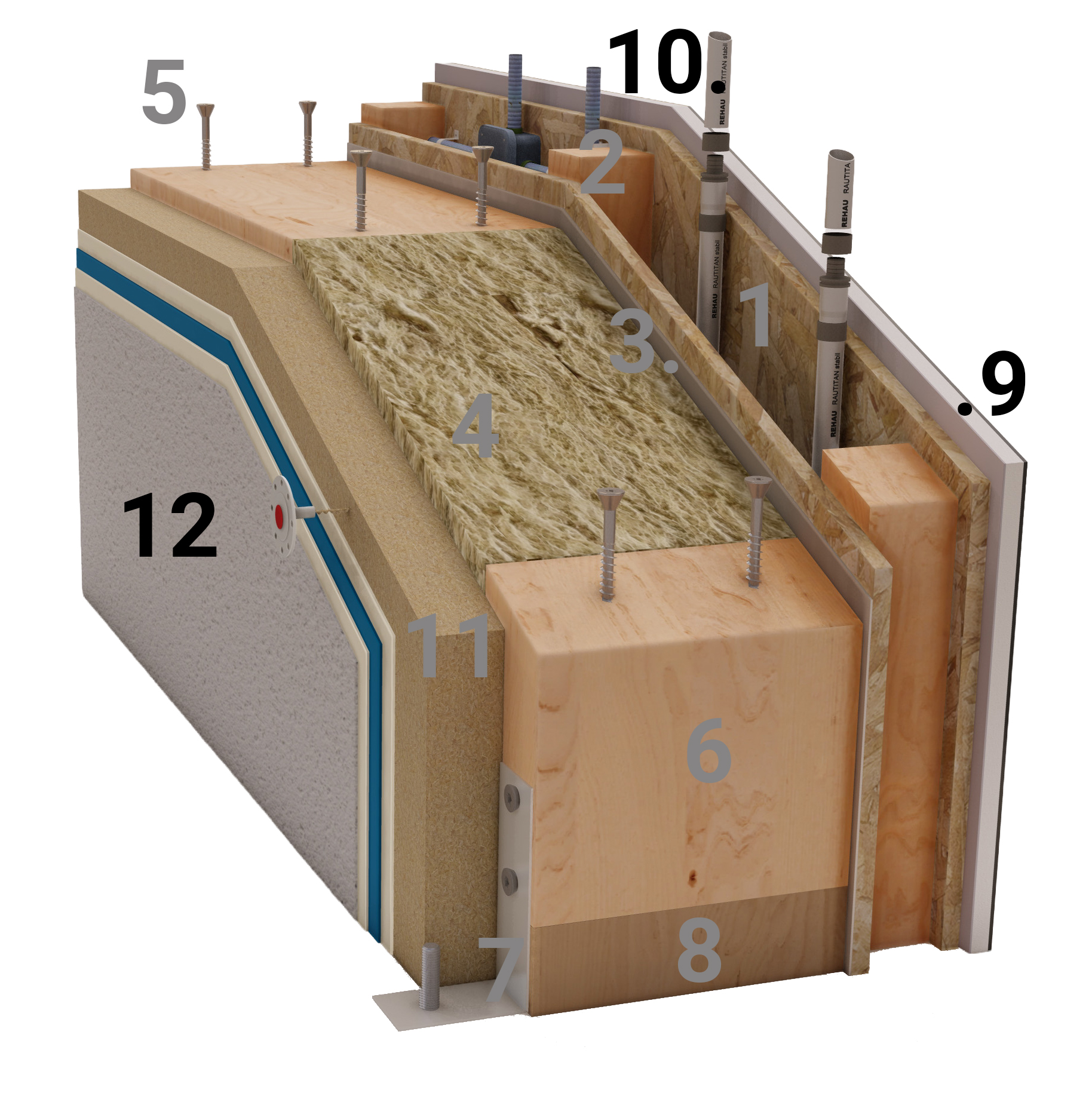
1 – American wooden shielding (OSB) | λ=0.130(W/mK)
OSB 11.1 mm of Canadian origin from LP factory in Americas, category 3- APA waterproof with immense mechanical properties. This strengthens the construction and allow us to fasten any weight anywhere on the wall, without the use of special dowels.
2 – Spacers | λ=0.300 W/(mK)
Creates the space to house the electrical wiring and plumbing infrastructure.
3 – Vapor stop control layer | λ=0.300 W/(mK)
Provides insulation to the structure and protects from moisture, preventing the appearance of water vapor that could gradually cause damage to the structure.
4 – Natural mineral wool ECOSE Technology® (category A1 non-combustible material) | λ=0,035(W/mK)
The basic thermal insulation material of the frame. Natural mineral wool offers excellent thermal insulation, sound insulation and fire resistance (category A1 non-combustible materials). Raw materials for the production of mineral wool fiber are amphibolite, dolomite, or limestone and bauxite rocks. The production of mineral wool is done in an electric oven. This method has an advantage over the blast furnace method used so far, because it achieves spacial uniformity in the fibers produced through the constantly controlled melt temperature, also minimizing the enviromental impact.
5 – Reinforced support with self-tapping Torx screws and ring shank nails
Connection of individual wall sections using certified Torx studs (ETA-11/0030), which offer a better fit, as they allow better control of the applied torque during screwing.
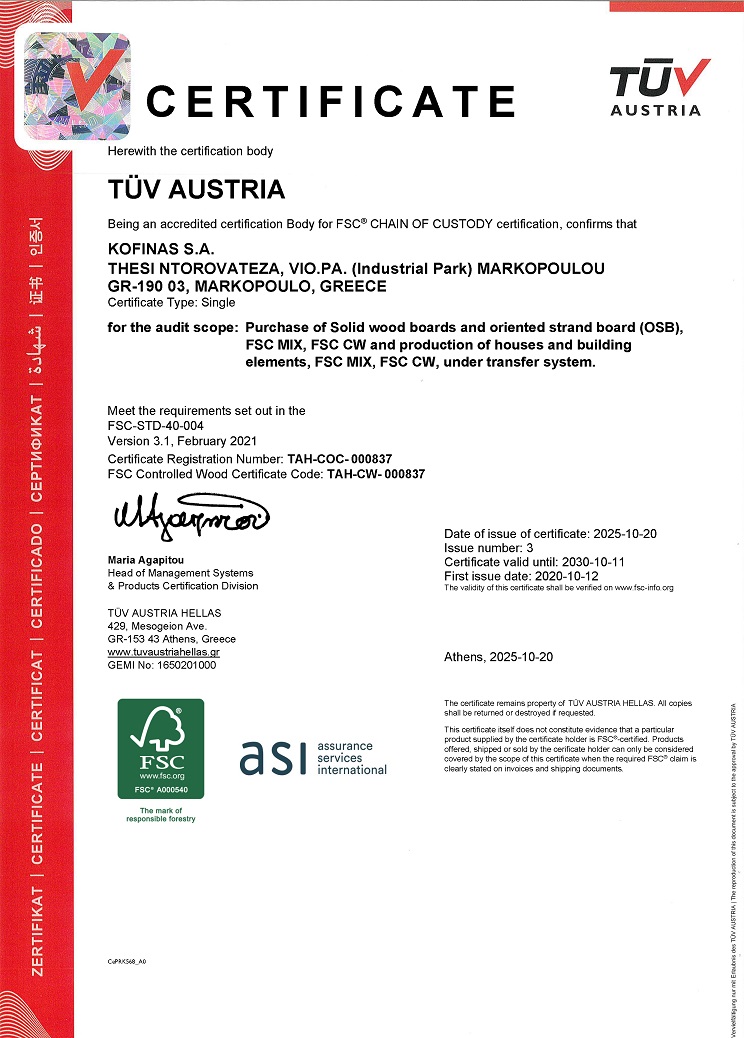
6 – Wooden frame Swedish pine certified with FSC
The wood of the framing construction, which is:
- Swedish: A really compact type of timber.
- Pine: Better moisture resistance.
- Dried: The timber is dried in a furnace for weeks, undergoing a natural deworming process, also reaching the ideal – for house construction – level of humidity, which is 15-16%.
- Ecological: The timber does not contain chemical substances, and the policy of the Swedish Timber Industry comforms with limiting carbon dioxide emissions.
- Planned: Comes with perfectly flat surfaces which, in conjunction with the connection methods used on our factory, can achieve a perfect assembly with no margins of error, at the joints of all the construction parts of the house.
- FSC CoC: This timber comes from closely controlled forests, in which for each tree that is cut, they are 3 trees or more planted in its place.
- C24 class: Great mechanical strength, showing up to 80% more carrying capacity when compared to conventional timber.
7 – Metal compaction corners
With these metal angles, the construction is rigidly connected to the reinforced concrete base. In this way, we have a “well-knit” construction with increased mechanical resistance and improved antiseismic behaviour.
8 – Wall-base waterproofing
The base of the wall is sealed from moisture, decay and insect damage, by using Use Class 3 (UC3) treated beams. They protect the logs from damage that could allow potential water condensation on the concrete base, improving the durability of the house.
9 – Internal gypsum shielding
10 – Electrical & plumbing placement
11 – Steico® Special Dry thermal insulation (option 2)
12 – Facade finishing coating of your choice